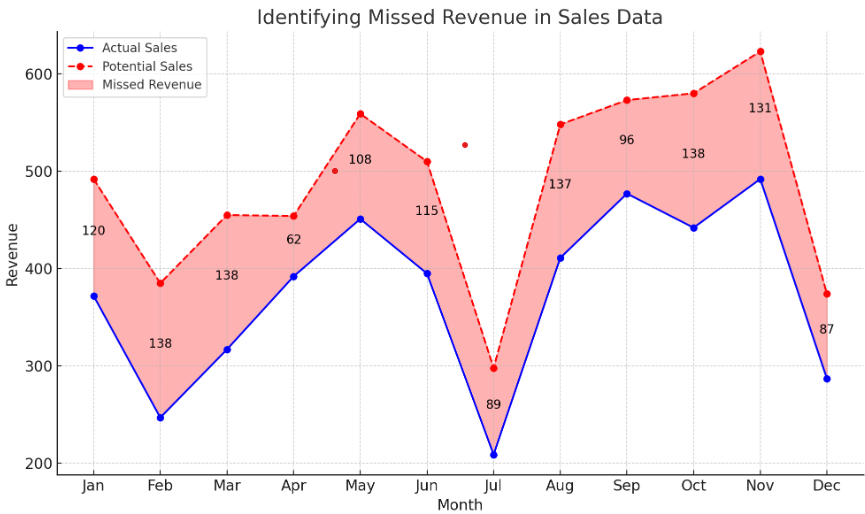
Case Study : Identifying Missed Revenue Through Data Analysis
In my previous role within sales operations in a few companies, I played a crucial role in uncovering missed revenue opportunities. By using some data analysis approaches, I was able to pinpoint discrepancies that resulted in a substantial financial impact.
The Challenge :
Accurate sales data is vital for any organization, ensuring a clear picture of potential revenue and the health of the sales pipeline. However, inconsistencies can sometimes arise due to manual data entry or human error. During this time, I noticed a potential gap between forecasted revenue and actual bookings.
Uncovering the Discrepancies :
To gain a deeper understanding of the potential revenue gap, I implemented a comprehensive analysis strategy. This strategy involved two key steps :
- Sales Report Analysis : I began by closely monitoring and analyzing daily sales reports. This analysis focused on comparing:
- Forecasted figures against actual bookings to identify any deviations.
- Current sales figures against past data (e.g., last month, last year) for trends, particularly focusing on products with renewals and recurring contracts.
- Detailed Transaction Review : I then leveraged SQL queries and Excel formulas to examine individual customer account transactions. This detailed review revealed discrepancies within specific accounts caused by inaccurate account information entered into the revenue system.
Causes of Missing Revenue:
As mentioned earlier, several factors can contribute to missing revenue. Here’s a breakdown of some common causes :
- Incorrect Account Information : Partners may enter an incorrect account name that doesn’t match the database, leading to missed revenue in a few ways:
- Using an unregistered child account.
- Entering a non-existent account name, even if similar to an existing one.
- Utilizing an unregistered child ID account and creating a new one.
- Product Line and Licensing Errors : Incorrectly assigning a product line or licensing type can impact contract renewal procedures, potentially leading to missed revenue if renewals are not captured correctly.
- Lack of Awareness Among Stakeholders : Sales, Business Development (BD), and Channel/Partner teams must be aware of the correct revenue allocation channels to prevent revenue loss. When these stakeholders are uninformed, revenue might be directed incorrectly.
- Renewal/Recurring Mismatches : Discrepancies between renewals and recurring revenue can also contribute to missing revenue. tThe causes : Incorrect Account Information – This could involve associating recurring revenue with the wrong customer account. Customer Churn – Customers may choose not to renew a specific product or service, leading to a decline in recurring revenue. Non-Renewal of Specific Components – If a customer chooses not to renew a particular component within a larger product suite, it could lead to missed recurring revenue.
Taking Action and Measuring Impact :
Once the root cause was identified, I communicated my findings to the sales team and relevant departments. Through collaboration, we implemented a process for verifying customer names during the sales cycle. Additionally, we conducted a historical review of past transactions to identify potential missed revenue. The results were positive. By focusing on data accuracy and addressing these common causes of missing revenue, we were able to recover a significant amount of missed revenue. This not only improved our overall sales performance but also provided valuable insights for future data management practices.
This experience highlighted the importance of data analysis within sales operations. By taking a data-driven approach, we were able to identify and address critical issues impacting revenue capture. This case study demonstrates the value of :
- Regular data review : Proactive monitoring can help identify potential discrepancies before they become significant problems.
- Collaboration : Working across different departments (sales, BD, Channel, Finance) is essential for implementing effective solutions based on data insights.
- Data accuracy : Ensuring clean and accurate data throughout the sales cycle is fundamental for reliable forecasting, informed decision-making, and preventing missed revenue opportunities.
- Stakeholder awareness : Educating all relevant stakeholders on proper revenue allocation channels minimizes misdirected revenue.
By proactively addressing these areas and employing data analysis techniques, organizations can significantly improve the accuracy of their revenue capture and prevent financial losses.